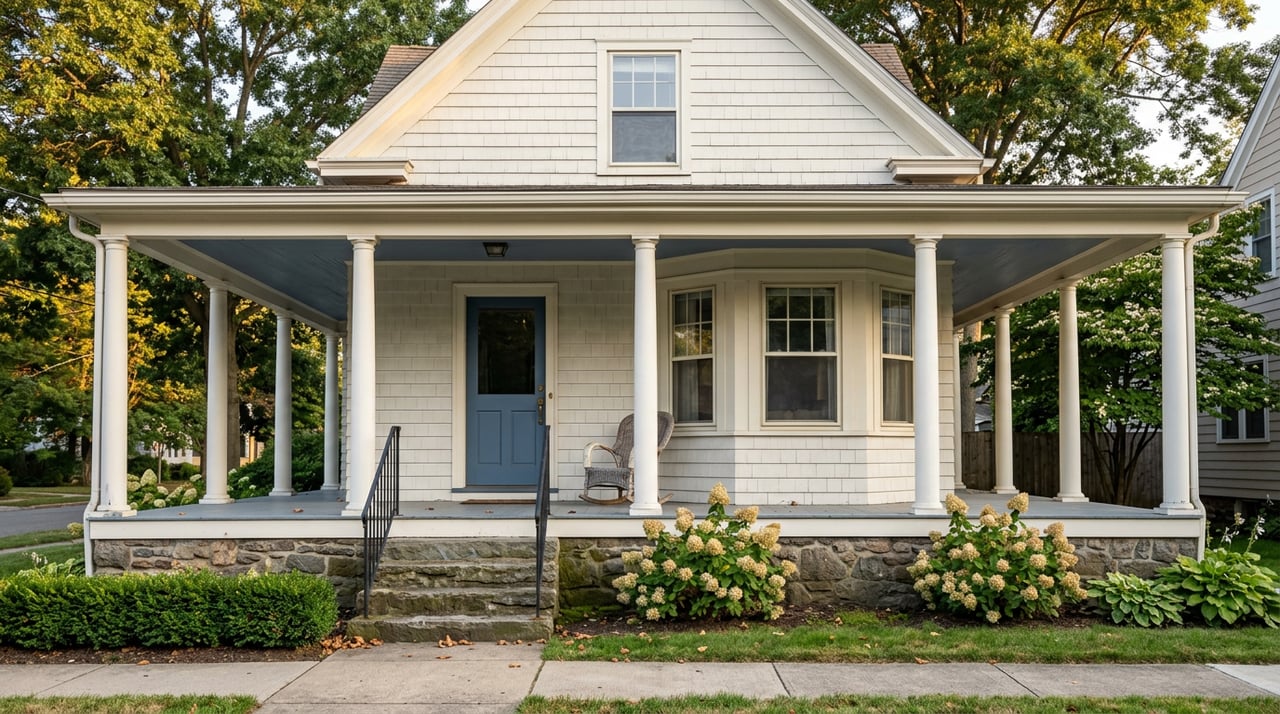
Walk down Albemarle Road toward Argyle on Halloween night and you will find the street closed to normal foot traffic in the best possible way. Families spill off the sidewalks and into the road itself, strollers parked three deep, a horn section warming up somewhere near the corner. The destination is 1306 Albemarle Road, a 1905 Queen Anne designed by architect John J. Petit for a local dye manufacturer named John S. Eakins, now owned by Pulitzer Prize winning playwright David Lindsay-Abaire and his wife Chris. Skeletons scale the turret. Animatronic clowns work the porch. It is, by most accounts, one of the most decorated houses in Brooklyn.
Every write-up about this house focuses on the decorations. Fewer ask why a residential block with no bar, no commercial strip, and no through traffic can absorb a crowd this size, year after year, without the night turning into a logistics problem. The answer has less to do with what Lindsay-Abaire builds every October and more to do with what developer Dean Alvord built in the 1890s.
The Malls Weren't Built for Trick-or-Treaters
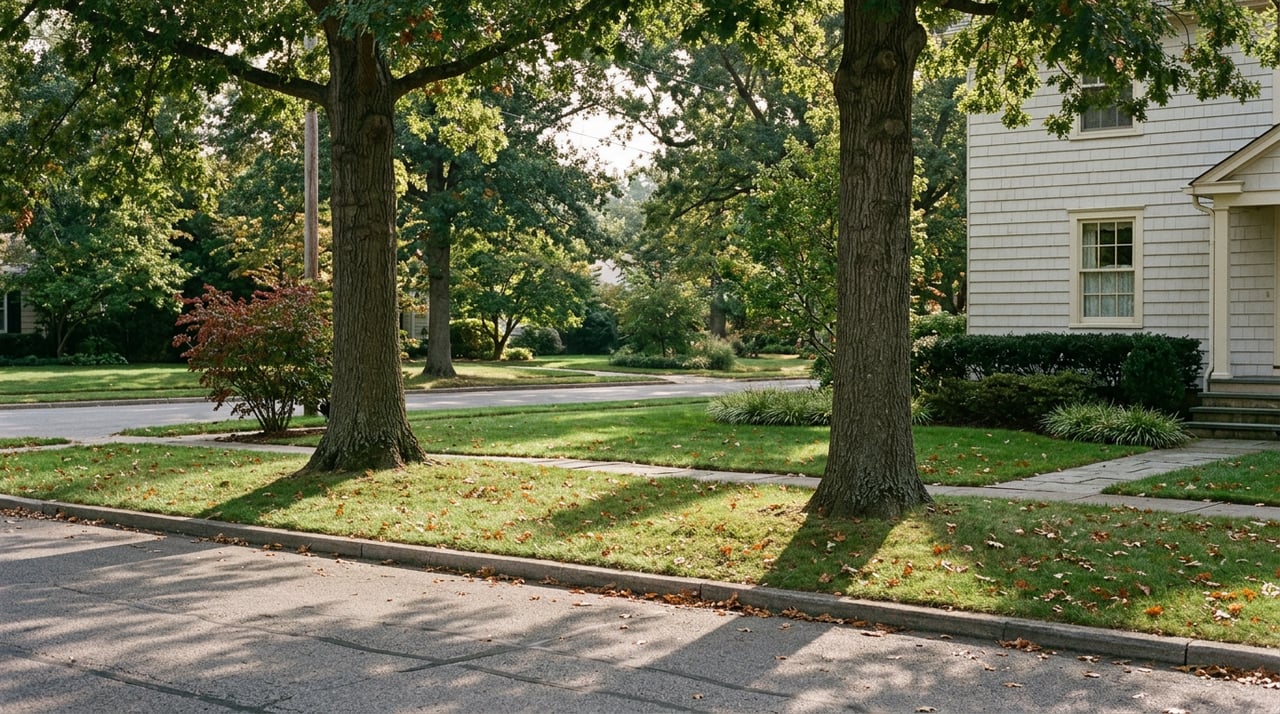
Prospect Park South was platted as a planned suburban enclave, not an extension of the Brooklyn street grid. Alvord's plan called for oversized lots, freestanding houses instead of rowhouses, and wide streets bisected by landscaped center medians that residents still call the malls. The design was meant to slow traffic and create a genteel, park-like setting for single-family living. Nobody involved was thinking about pedestrian crowd capacity.
That is exactly what the malls provide now. Local event listings describe the parade route as looping marchers around the Albemarle Road malls, and that phrasing only makes sense because those medians function as a continuous, walkable green spine rather than a series of ordinary intersections. A denser block with parked cars running curb to curb would not have anywhere for several hundred people to stand, let alone march. Prospect Park South does, because Alvord built it that way for reasons that had nothing to do with Halloween.
Chris Lindsay-Abaire, who has led the parade with her husband since it began, put the effect simply after an early parade drew a bigger crowd than organizers expected: "It's a really nice event not just for Prospect Park South, but for other neighborhoods as well."
One House, Thirteen Octobers
The parade and the decorated house are the same origin story. Lindsay-Abaire has said he started with string lights and webbing in 2013, the same year he and Chris began organizing the parade itself. Growth was fast. By the third year, in 2015, local coverage reported that the crowd was already nearly double the size of the previous year's event, with the 70th Precinct assisting to keep the street safe as attendance climbed.
That trajectory did not level off. Gothamist has returned to the house as a recurring feature for years running, at one point calling it possibly the most impressive Halloween display in the entire city rather than just the neighborhood. Untapped New York's history of the property traces the architectural pedigree back to Petit and Eakins, giving the display a backstory that outlasts any single year's decorations.
By last October, the house had become formal enough to anchor a paid walking tour. The New York Adventure Club ran "Exploring the Victorian Mansions of Prospect Park South: Halloween Edition," led by licensed tour guide Norman Oder, taking visitors past the neighborhood's Japanese House and several Petit-designed mansions before ending near the Cortelyou Road Q stop. A private homeowner's Halloween hobby now shares billing with a guided architecture tour.
If You're Going This Year
A few practical notes for anyone planning around the parade:
- Marchers have traditionally gathered at the house around 5:30 pm on Halloween itself, with cider and treats served beforehand.
- Organizers have asked for volunteer percussionists and horn players to help lead the procession around the malls, so bring an instrument if you have one.
- Grab dinner first at Wheated on Church Avenue, the pizza and cocktail spot Brooklyn Eagle notes as one of Lindsay-Abaire's own regular stops.
- If you want a nightcap after the kids are home, Hinterlands is the board game bar the same coverage names as his other neighborhood haunt.
- The house has stayed a fixture of national Halloween roundups for years running, so expect company if you go, especially near dusk when the lighting kicks in.
Why the Model Doesn't Travel
This is not unique to one house on one block. Just a few blocks away, West Midwood has its own long-running Halloween parade tradition, a separate event with its own gathering point on Glenwood Road and its own volunteer bakers. Both micro-neighborhoods share the same underlying pattern: they were platted in the same era, by developers working from the same playbook of freestanding houses on oversized lots with generous, tree-lined streets. That layout, built for turn of the century suburban calm, happens to double as ready made infrastructure for a modern block party that a standard rowhouse street simply cannot host at the same scale.
None of this is an accident of good luck. It is what happens when a single family's decorating hobby meets a street plan built wide enough to hold it. Alvord could not have anticipated animatronic clowns or a licensed walking tour when he laid out Albemarle Road, but the malls he built for quiet Sunday strolls turned out to be exactly what a neighborhood needed a century later to host one of Brooklyn's most attended free nights of the year.
If you already live on one of these blocks, you know the sound of the horn section warming up before the march starts. If you're walking through for the first time this fall, take a minute to notice the medians themselves, not just the skeletons climbing the turret above them. The street did the work long before the decorations arrived.
If wandering these blocks on Halloween night has you wondering what it actually takes to land a house on one of them, the Rosenberg Sackin Team knows Prospect Park South and the rest of Victorian Flatbush block by block. Reach out for a no pressure conversation about the market, starting with a free home valuation and consultation.